Washington
Little WomenWashington is the remote wartime setting that governs the March family’s emotional and practical life without being directly shown. It is where Mr. March serves as a chaplain, becomes dangerously ill, and receives care in a hospital; for his wife and daughters, the city represents both duty and peril, linking their domestic sacrifices to the larger national conflict.
Wartime Distance and Family Sacrifice
Washington first exists in the March household as the destination of Mr. March’s service. Although too old to be drafted and not strong enough to serve as a soldier, he has gone as a chaplain, an act Meg regards as especially admirable. Jo wishes she could accompany him as a drummer or nurse, while Amy imagines the discomforts of military life in tents, with poor food and tin cups. Their different responses establish Washington as both a patriotic cause and a source of anxious separation.
During the Christmas discussion, Jo states that the family has not truly got their father because he is far away where the fighting is. The girls’ inability to know whether he will return makes the absence more severe than an ordinary separation. Their mother’s request that they give up Christmas presents therefore acquires a wartime meaning: the March household is asked to practice small economies because soldiers are suffering in the army. Washington remains unseen, but it supplies the moral pressure behind the family’s restraint.
The Hospital Telegram
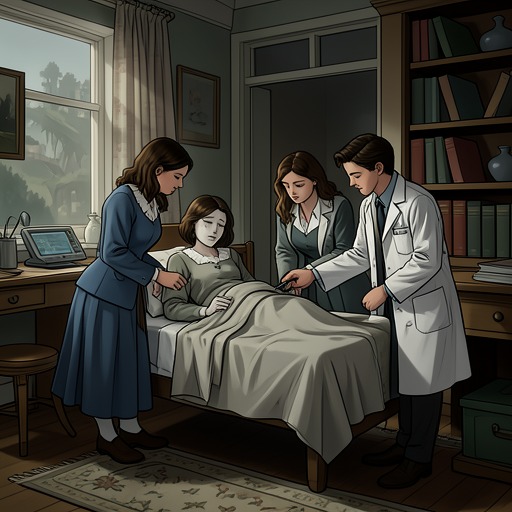
Washington becomes the scene of acute danger when a telegram arrives from Blank Hospital. The message, signed by S. Hale, announces that Mr. March is very ill and orders Mrs. March to come at once. The briefness of the communication intensifies its force: two lines transform an ordinary day into a crisis, and Mrs. March collapses as though the paper had physically wounded her. The family’s fear is not abstract; the hospital’s location makes the father’s illness both real and unreachable.
Mrs. March immediately organizes the journey. She instructs Jo to obtain supplies, asks Beth to request old wine from James Laurence, tells Amy to bring down the black trunk, and has Meg help locate her belongings. She insists that Mr. March receive the best care available, recognizing that hospital stores may not be adequate. James Laurence offers every comfort he can think of and promises to protect the girls during her absence, while John Brooke becomes involved in the arrangements. Washington thus draws the family’s neighbors into an extended network of care, converting private distress into collective action.
Letters, Bulletins, and Suspended Time
Once Mrs. March reaches Washington, the city is mediated through daily reports rather than direct description. John Brooke sends a bulletin every day, and the March sisters anxiously read the dispatches as Mr. March’s condition gradually improves. Their letters to their mother become a record of the household left behind: Meg helps manage the home, Jo undertakes difficult work, Beth remains faithful to her duties and finds comfort at her little piano, and Amy tries to improve her domestic skills.
Hannah Mullet’s letter adds a practical account of life during the separation. She describes Meg learning housekeeping, Jo’s energetic but error-prone attempts at laundry, Beth’s reliability in shopping and accounting, and Amy’s ability to remain cheerful while wearing her best clothes and eating sweet things. Her report also records that Theodore Laurence continues to amuse the girls and that James Laurence sends them many things. The Washington correspondence therefore does more than convey medical news: it measures the sisters’ growth under pressure and shows how the household reorganizes itself around absence.
The distance also magnifies later fears. When Beth contracts scarlet fever after visiting the Hummel family, Jo feels that Washington is immensely far away because Mrs. March cannot be summoned at once. The family’s medical knowledge is limited, and Hannah Mullet, Dr. Bangs, and the sisters must manage the danger at home while concealing Beth’s illness from their mother. Washington consequently becomes a double source of helplessness: Mr. March is ill there, while the family faces a second medical crisis without the person who would ordinarily direct them.
Separation, Care, and Return
Mrs. March’s departure leaves the girls under Hannah Mullet’s care and James Laurence’s protection. Before leaving, she tells them not to become idle or lose themselves in grief, but to continue their work, maintain hope, and remember that they are never fatherless. Her instruction turns Washington into a test of domestic discipline: the daughters must sustain the household while separated from both parents’ ordinary presence.
The test becomes especially severe when Mr. March suffers a relapse in Washington and cannot return for a long while. At the same time, Beth’s fever becomes far worse than the girls initially understand, and the March home seems shadowed by possible death. Meg recognizes the value of love, protection, peace, and health; Jo learns to appreciate the depth of Beth’s quiet, selfless character. Washington’s physical distance therefore produces inward changes at home, forcing the sisters to discover what their family bonds mean when ordinary security is suspended.
Three years later, the war is over and Mr. March is safely home. The Washington episode is consequently remembered not as a permanent separation but as a crisis through which the family passes. His return restores the family’s central figure: although the energetic women appear to govern the household, he remains its head, conscience, anchor, and comforter. Washington’s narrative significance lies in this contrast between distance and belonging. It is the offstage place of war, illness, and uncertainty, but its most lasting effect is to reveal the March family’s capacity for sacrifice, mutual care, and steadfast hope.